
American Holly
Ilex opaca
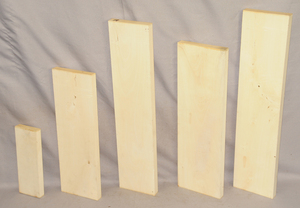
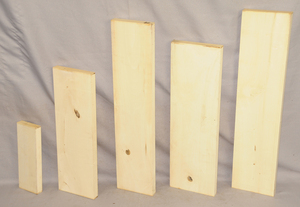
Holly is the whitest wood commercially available. Our stock was cut during the winter and quickly dried in a vacuum kiln to prevent discoloration. The result is very white wood without gray or bluish staining. The wood is fine-grained and is excellent for turnery, inlays, musical instrument edge bandings, etc. The grade is common and better which means that there can be some defects, mainly knots.
Item Number: W44469

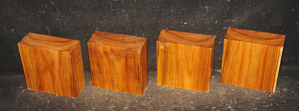
Canarywood Bowl Blanks
Centrolobium paraense
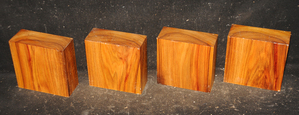
This Brazilian hardwood is occasionally seen to have the bright, brilliantly hued colors as found in these boards. It has medium density and is easy to work and finish.
Item Number: W44465
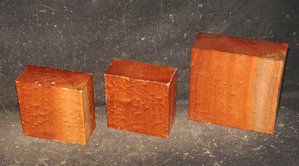
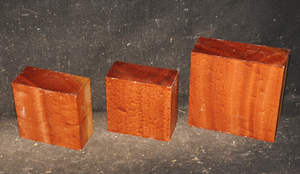
Pomelle Sapele Bowl Blanks
Entandrophragma cylindricum
The Sapele tree is found in tropical West & Central Africa. Even when without figure as this board Sapele has an amazing luster and takes a beautiful polish.
Item Number: W44464
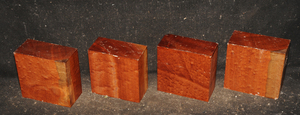
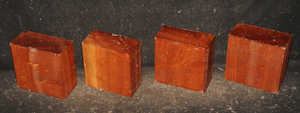
Pomelle Sapele Bowl Blanks
Entandrophragma cylindricum
The Sapele tree is found in tropical West & Central Africa. Even when without figure as this board Sapele has an amazing luster and takes a beautiful polish.
Item Number: W44463
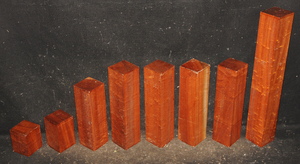
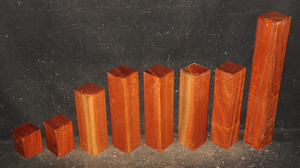
Figured Sapele Turning Squares
Entandrophragma cylindricum
The Sapele tree is found in tropical West & Central Africa. Even when without figure as this board Sapele has an amazing luster and takes a beautiful polish.
Item Number: W44462
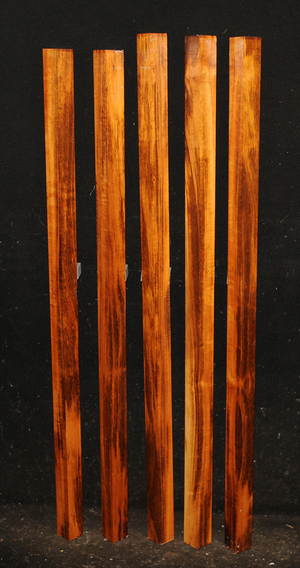
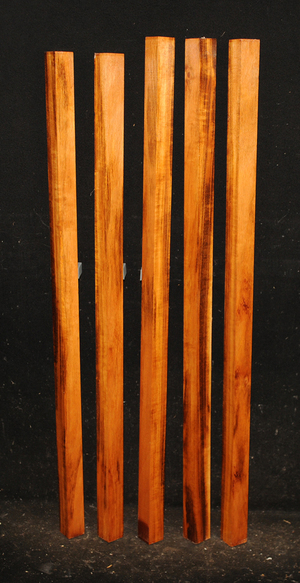
Goncalo Alves Cane Blanks
Astronium sp.
This South American wood is very fine-grained and attractively colored with black streaks and striping. Hard and heavy, it turns quite well and takes a glassy-smooth polish.
Item Number: W44455
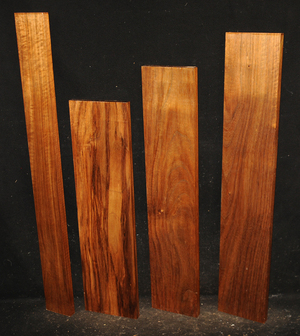
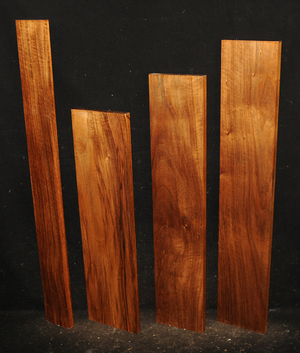
Etimoe
Copaifera salikounda
This West African wood was more popular in the 1970's and 80's when we first imported it. But it is such a nice wood that when we were recently offered a nice log from Ghana we jumped at it and had it sawed mostly quartersawn and then kiln-dried it. The heartwood is reddish-brown with sometimes a coppery cast. On the quartersawn surface there is often light and dark striping which is very attractive under a finish. It has a fine to medium texture and is easily milled and sanded. Excellent for furniture, cabinetry, paneling, and flooring.
Item Number: W44454
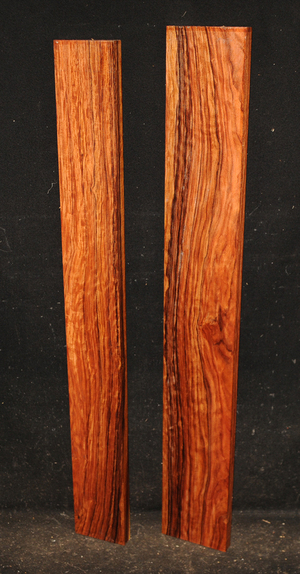
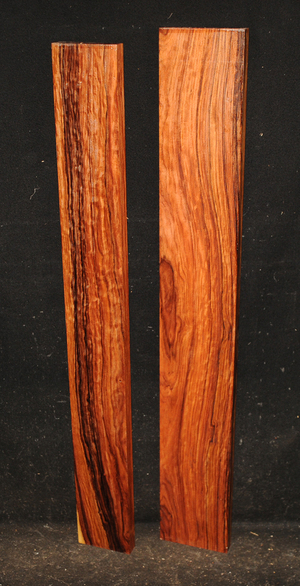
Figured Santos Rosewood
Machaerium sp.
This wood has gained in popularity since the early 1990's when Brazilian Rosewood was designated an endangered species. Furniture manufacturers used it as a Brazilian Rosewood substitute but it stands on its own as an instrument tone wood.
Item Number: W44452
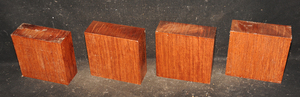
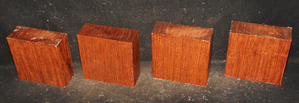
Bubinga Bowl Blanks
Guibourtia tessmannii
This is one of the lightest density commercial wood at 8-12 lbs per cubic foot. Most Balsa comes from Ecuador and at the age of 6 years may be 50-60 feet high with a diameter of 24-30 inches. It is usually harvested at around 7 years of age. Used for novelties, model airplanes, floats, surfboards, break-away furniture and interior filler for certain electric guitars. And remember that Thor Heyerdahl's raft Kon-Tiki was made from Balsa logs and carried him 5000 miles from South American to the Tuamotu Islands.
Item Number: W44450
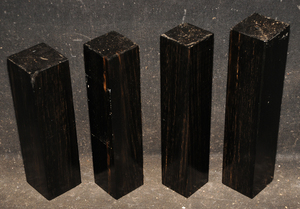
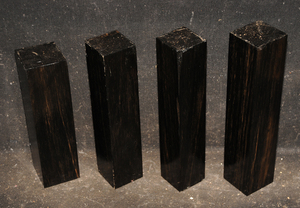
West African Ebony Turning Squares
Diospyros crassiflora
Sometimes called Gabon or Gaboon, this Ebony is sometimes jet black but oftentimes has grayish streaks that mostly disappear when finished or after the made object has been put into service. This Ebony has a marked resistance to checking that is characteristic of some of the Indian and Asian species. It has a wonderful texture and is easily carved, planed, turned, and milled. It is fairly fine-grained and takes a high polish. This Ebony usually originates in either Cameroon or Nigeria and the logs are rough hewn in the forest and oftentimes brought to the nearest road by human porters. With the disappearance of other species of black Ebony this species is fast becoming the Ebony of choice.
Item Number: W44449
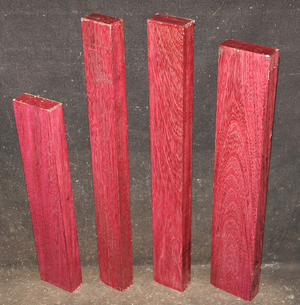
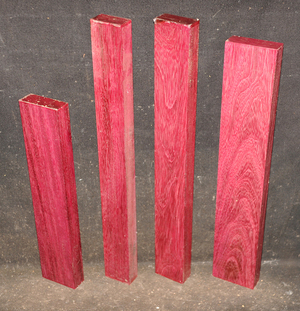
Purpleheart
Peltogyne sp.
The best colored & figured Purpleheart comes from Bolivia. It is also finer-grained than other Purpleheart species found elsewhere. Air-dried.
Item Number: W44448
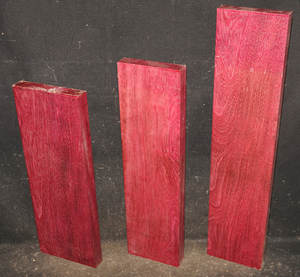
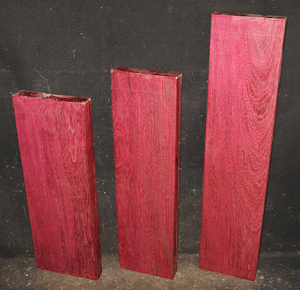
Purpleheart
Peltogyne sp.
The best colored & figured Purpleheart comes from Bolivia. It is also finer-grained than other Purpleheart species found elsewhere. Air-dried.
Item Number: W44447
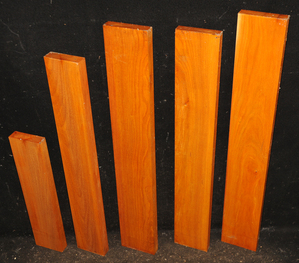
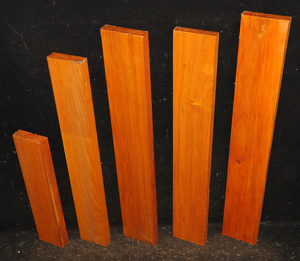
Chakte-viga
Guilandina sp.
Found in the Yucatan Peninsula in Mexico and related to Pernambuco (Guilandina echinata). It is sought after for house posts in Mexico as it is said to be impervious to termites and other insect pests. It is a lovely light to dark orange color, is fairly hard and heavy, and is capable of taking a very high polish. Rare.
Item Number: W44446
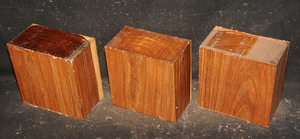
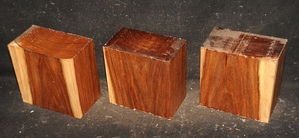
Narra Bowl Blanks
Pterocarpus indicus
Also called New Guinea Rosewood. It is a beautiful, highly lustrous golden yellow color sometimes with reddish streaks. A nice turning wood it is also used in furniture, jewelry boxes, handles, etc. It is easy to work and glue and takes a nice polish.
Item Number: W44444
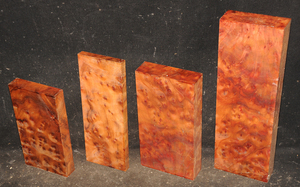
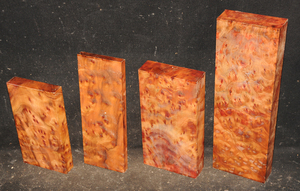
Camphor Burl
Cinnamomum sp.
This rare burl is from S.E. Asia and is seldom seen on the world market. It is fine-grained and varies in color from a light reddish-brown to almost scarlet. It is easy to work and has a very pungent, spicy scent. For a burl it is remarkably stable. Green to partially air dried.
Item Number: W44441
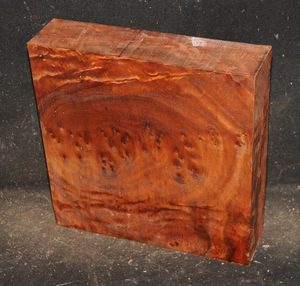
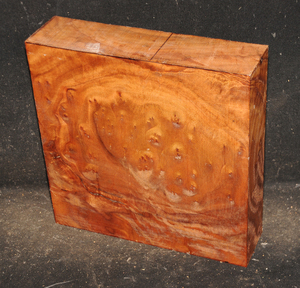
Camphor Burl Bowl Blank
Cinnamomum sp.
This rare burl is from S.E. Asia and is seldom seen on the world market. It is fine-grained and varies in color from a light reddish-brown to almost scarlet. It is easy to work and has a very pungent, spicy scent. For a burl it is remarkably stable. Green to partially air dried.
Item Number: W44438
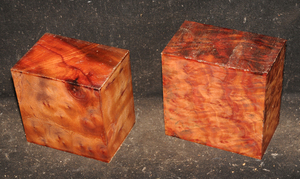
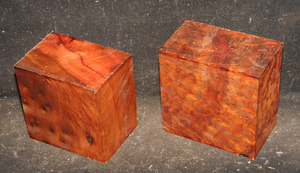
Camphor Burl Bowl Blanks
Cinnamomum sp.
This rare burl is from S.E. Asia and is seldom seen on the world market. It is fine-grained and varies in color from a light reddish-brown to almost scarlet. It is easy to work and has a very pungent, spicy scent. For a burl it is remarkably stable. Green to partially air dried.
Item Number: W44437
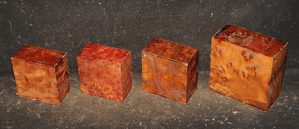
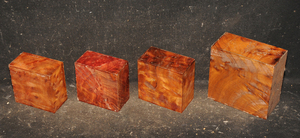
Camphor Burl Bowl Blanks
Cinnamomum sp.
This rare burl is from S.E. Asia and is seldom seen on the world market. It is fine-grained and varies in color from a light reddish-brown to almost scarlet. It is easy to work and has a very pungent, spicy scent. For a burl it is remarkably stable. Green to partially air dried.
A has a slight crack on one edge. Priced accordingly.
Item Number: W44436
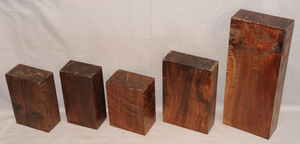
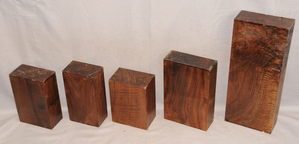
Figured Claro Walnut
Juglans hindsii
A tree found in Southern Oregon and Northern California with the best material coming from the San Joaquin Valley. Lighter in color than Eastern Black Walnut (Juglans regia) it is often found with curly and quilted figure. Burly stumps are also a valuable source of wood for veneers, gunstocks, and wood turning blanks.
Item Number: W44435
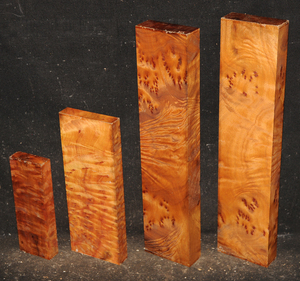
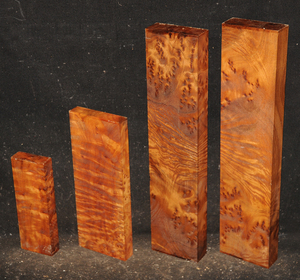
Camphor Burl
Cinnamomum sp.
This rare burl is from S.E. Asia and is seldom seen on the world market. It is fine-grained and varies in color from a light reddish-brown to almost scarlet. It is easy to work and has a very pungent, spicy scent. For a burl it is remarkably stable. Green to partially air dried.
Item Number: W44429
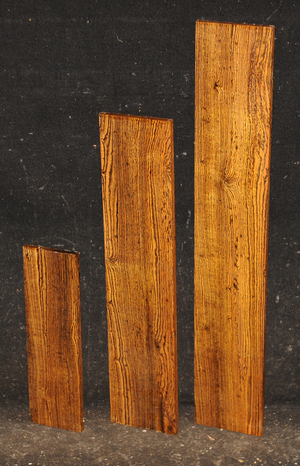
Mexican Bocote Thins
Cordia elaeagnoides
Bocote is an oily wood with a yellowish to dark brown color accented with irregular black stripes and streaks. It has a spicy smell and is hard, heavy and strong. It is easy to work and takes a very nice polish. This beautiful wood is seldom seen in woodworker's shops.
Item Number: W44428
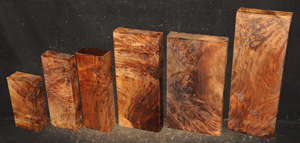
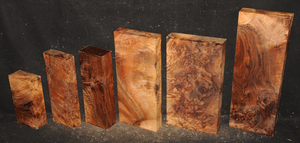
Figured Claro Walnut
Juglans hindsii
A tree found in Southern Oregon and Northern California with the best material coming from the San Joaquin Valley. Lighter in color than Eastern Black Walnut (Juglans regia) it is often found with curly and quilted figure. Burly stumps are also a valuable source of wood for veneers, gunstocks, and wood turning blanks.
Item Number: W44426
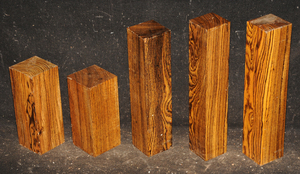
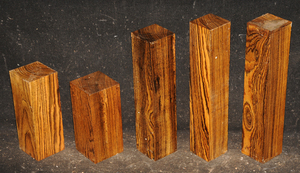
Mexican Bocote Turning Squares
Cordia elaeagnoides
Bocote is an oily wood with a yellowish to dark brown color accented with irregular black stripes and streaks. It has a spicy smell and is hard, heavy and strong. It is easy to work and takes a very nice polish. This beautiful wood is seldom seen in woodworker's shops.
Item Number: W44422
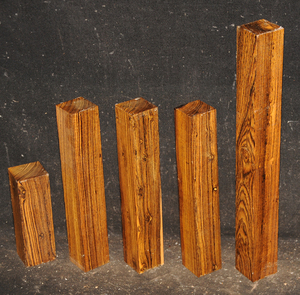
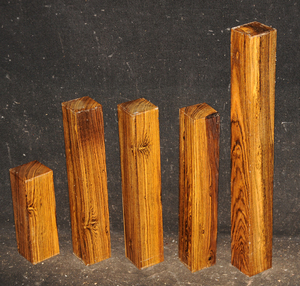
Mexican Bocote Turning Squares
Cordia elaeagnoides
Bocote is an oily wood with a yellowish to dark brown color accented with irregular black stripes and streaks. It has a spicy smell and is hard, heavy and strong. It is easy to work and takes a very nice polish. This beautiful wood is seldom seen in woodworker's shops.
Item Number: W44421
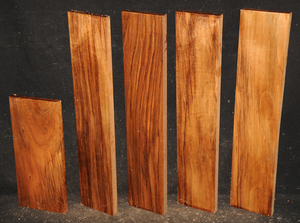
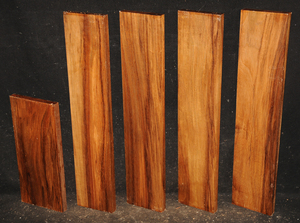
Etimoe
Copaifera salikounda
This West African wood was more popular in the 1970's and 80's when we first imported it. But it is such a nice wood that when we were recently offered a nice log from Ghana we jumped at it and had it sawed mostly quartersawn and then kiln-dried it. The heartwood is reddish-brown with sometimes a coppery cast. On the quartersawn surface there is often light and dark striping which is very attractive under a finish. It has a fine to medium texture and is easily milled and sanded. Excellent for furniture, cabinetry, paneling, and flooring.
Item Number: W44419
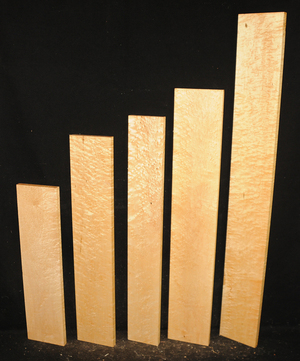
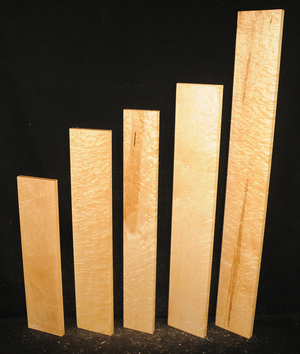
Bird's-eye Maple
Acer saccharum
The heartwood is white or cream to light brown or reddish brown. Figured somewhat like that of burl with many small eyes separate from each other. Hard and heavy, 45 lbs/cu ft. Easy to work and takes a smooth polish. U.S.A.
Item Number: W44418
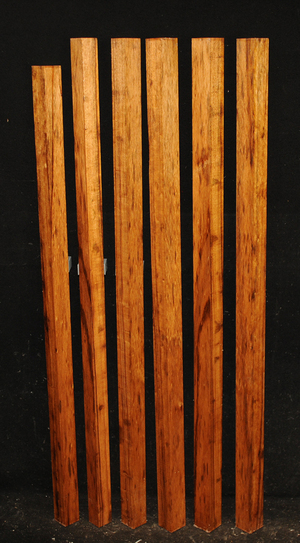
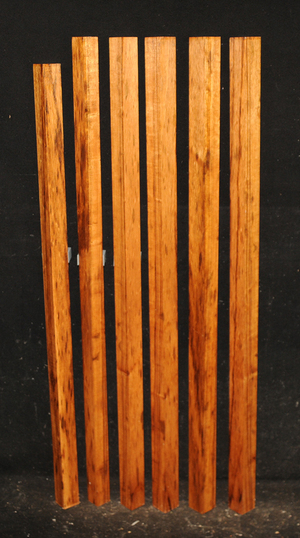
Goncalo Alves Cane Blanks
Astronium sp.
This South American wood is very fine-grained and attractively colored with black streaks and striping. Hard and heavy, it turns quite well and takes a glassy-smooth polish.
Item Number: W44417
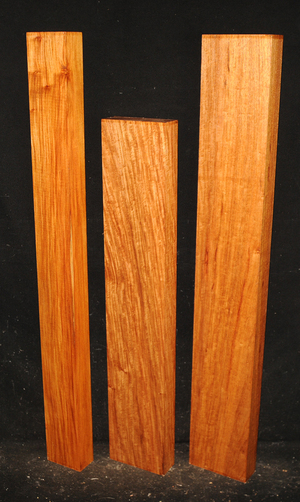
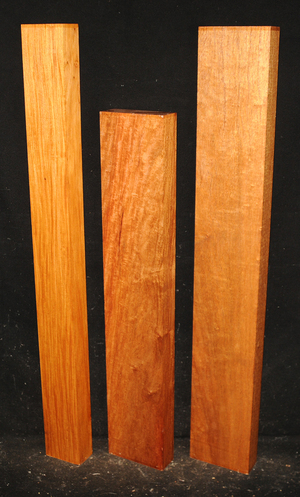
Figured Narra
Pterocarpus indicus
Also called New Guinea Rosewood. It is a beautiful, highly lustrous golden yellow color sometimes with reddish streaks. A nice turning wood it is also used in furniture, jewelry boxes, handles, etc. It is easy to work and glue and takes a nice polish.
Item Number: W44416
Katalox
Swartzia cubensis
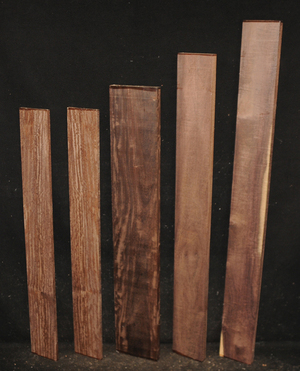
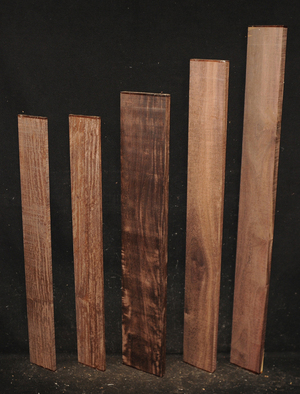
This is a large tree 2-4' diameter, by up to 120' tall from Mexico & Central America. The wood is very dense and fairly fine-grained. Because of its hardness it can be difficult to work but it takes a fine polish. Its dark color leads some to call it Mexican Ebano and very dark pieces can be used as a substitute for true black Ebony, especially in laminations and inlays. Straight-grained wood can be used for musical instrument fingerboards and bridge blanks.
Item Number: W44413
West African Ebony
Diospyros crassiflora
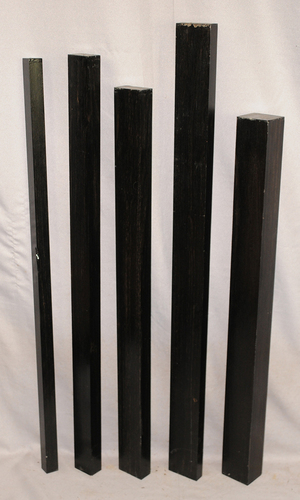
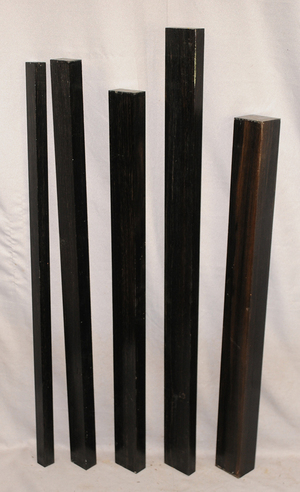
Sometimes called Gabon or Gaboon, this Ebony is sometimes jet black but oftentimes has grayish streaks that mostly disappear when finished or after the made object has been put into service. This Ebony has a marked resistance to checking that is characteristic of some of the Indian and Asian species. It has a wonderful texture and is easily carved, planed, turned, and milled. It is fairly fine-grained and takes a high polish. This Ebony usually originates in either Cameroon or Nigeria and the logs are rough hewn in the forest and oftentimes brought to the nearest road by human porters. With the disappearance of other species of black Ebony this species is fast becoming the Ebony of choice.
Item Number: W44412
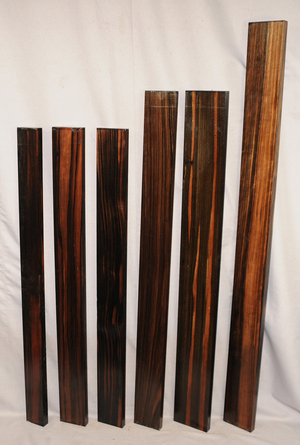
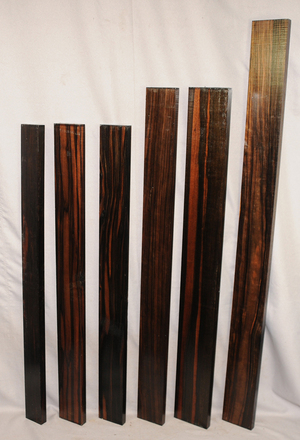
Macassar Ebony
Diospyros celebica
A classically striped Ebony from Asia. Quartersawn.
Item Number: W44411
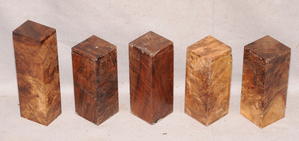
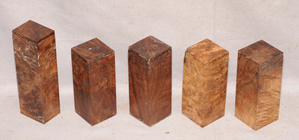
Figured Claro Walnut Turning Squares/Knife Handle Blanks
Juglans hindsii
A tree found in Southern Oregon and Northern California with the best material coming from the San Joaquin Valley. Lighter in color than Eastern Black Walnut (Juglans regia) it is often found with curly and quilted figure. Burly stumps are also a valuable source of wood for veneers, gunstocks, and wood turning blanks.
Item Number: W44410
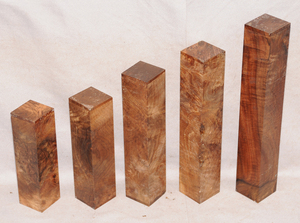
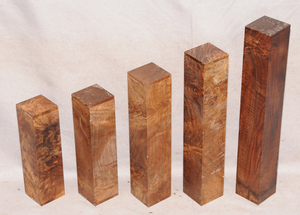
Figured Claro Walnut Turning Squares
Juglans hindsii
A tree found in Southern Oregon and Northern California with the best material coming from the San Joaquin Valley. Lighter in color than Eastern Black Walnut (Juglans regia) it is often found with curly and quilted figure. Burly stumps are also a valuable source of wood for veneers, gunstocks, and wood turning blanks.
Item Number: W44409
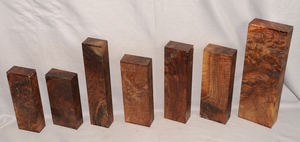
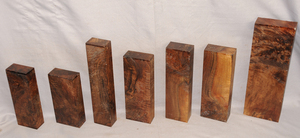
Figured Claro Walnut
Juglans hindsii
A tree found in Southern Oregon and Northern California with the best material coming from the San Joaquin Valley. Lighter in color than Eastern Black Walnut (Juglans regia) it is often found with curly and quilted figure. Burly stumps are also a valuable source of wood for veneers, gunstocks, and wood turning blanks.
Item Number: W44408
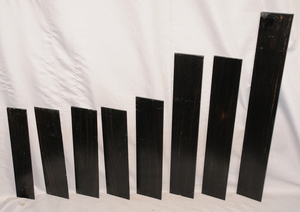
West African Ebony Thins
Diospyros crassiflora
Sometimes called Gabon or Gaboon, this Ebony is sometimes jet black but oftentimes has grayish streaks that mostly disappear when finished or after the made object has been put into service. This Ebony has a marked resistance to checking that is characteristic of some of the Indian and Asian species. It has a wonderful texture and is easily carved, planed, turned, and milled. It is fairly fine-grained and takes a high polish. This Ebony usually originates in either Cameroon or Nigeria and the logs are rough hewn in the forest and oftentimes brought to the nearest road by human porters. With the disappearance of other species of black Ebony this species is fast becoming the Ebony of choice.
Item Number: W44407
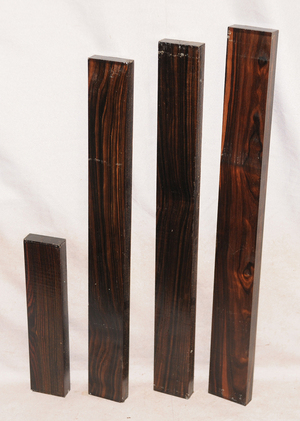
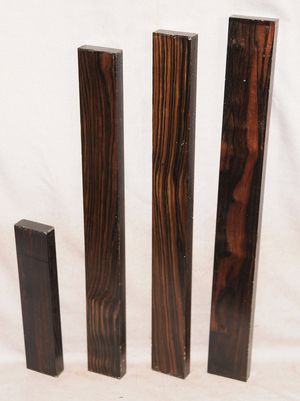
Macassar Ebony
Diospyros celebica
A classically striped Ebony from Asia. Quartersawn.
Item Number: W44406
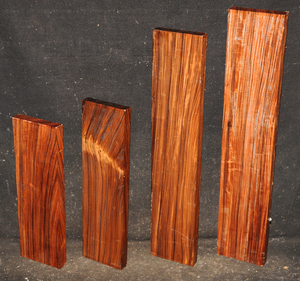
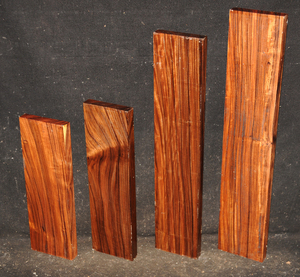
Santos Rosewood
Machaerium sp.
This wood has gained in popularity since the early 1990's when Brazilian Rosewood was designated an endangered species. Furniture manufacturers used it as a Brazilian Rosewood substitute but it stands on its own as an instrument tone wood.
Item Number: W44404
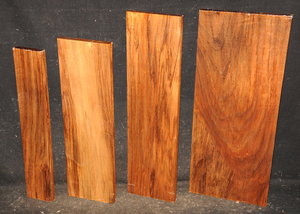
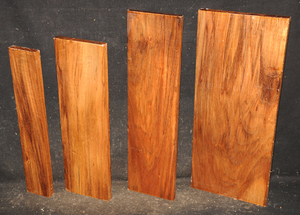
Etimoe
Copaifera salikounda
This West African wood was more popular in the 1970's and 80's when we first imported it. But it is such a nice wood that when we were recently offered a nice log from Ghana we jumped at it and had it sawed mostly quartersawn and then kiln-dried it. The heartwood is reddish-brown with sometimes a coppery cast. On the quartersawn surface there is often light and dark striping which is very attractive under a finish. It has a fine to medium texture and is easily milled and sanded. Excellent for furniture, cabinetry, paneling, and flooring.
Item Number: W44403
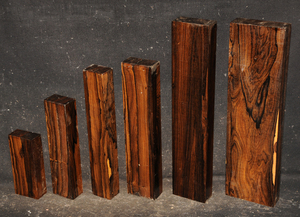
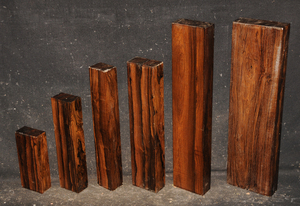
Ziricote
Cordia dodecandra
Ziricote is another timber we get from the Yucatan Peninsula of Mexico. It is a lovely wood with a very pronounced ray fleck on radial surfaces sometimes producing a "landscape" effect much like picture jasper.
Item Number: W44402
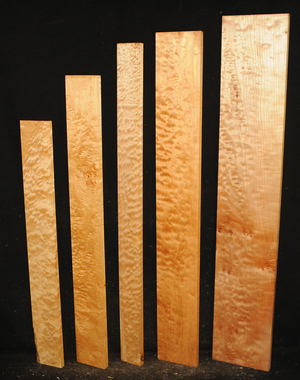
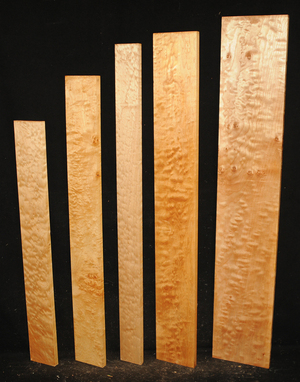
Quilted Big Leaf Maple
Acer macrophyllum
This tree is native to the Pacific Northwest. It has the distinction of having the largest leaf of the Maples-up to 15" in diameter. This is a soft Maple. The tree can produce many different types of figure, including quilted (tubular, popcorn, & cloud), curly (fiddleback, broken, & basketweave), and burl.
Item Number: W44401
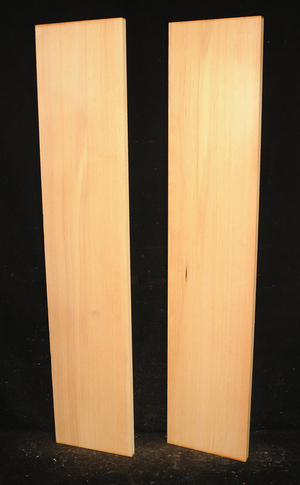
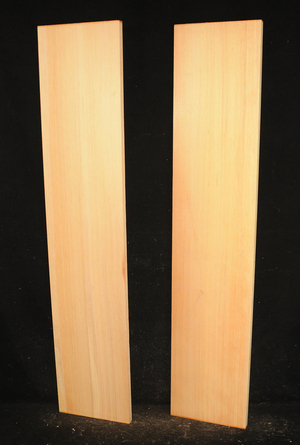
Vertical Grain Douglas Fir
Pseudotsuga taxifolia
Douglas Fir tends to be stiffer than either Spruce or Cedar.Air-dried.
Item Number: W44399
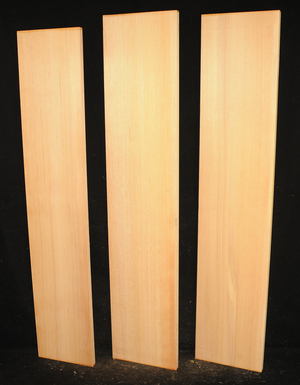
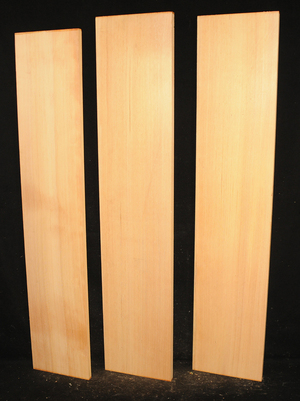
Vertical Grain Douglas Fir
Pseudotsuga taxifolia
Douglas Fir tends to be stiffer than either Spruce or Cedar.Air-dried.
Item Number: W44398
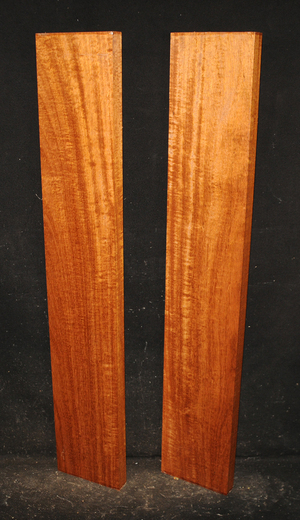
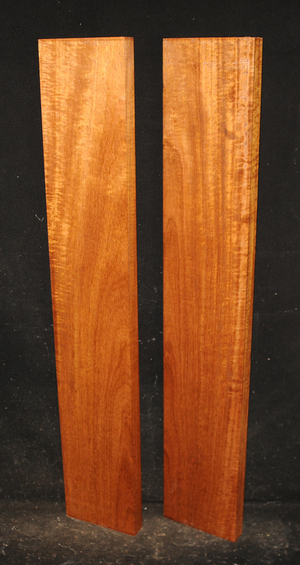
Figured Knobthorn Acacia
Acacia nigrescens
This South African tree is noted for its bark which has prominent knobby prickles. The heartwood is medium to dark brown and close grained. It is hard and heavy and takes a nice polish. Rare on the American market.
Item Number: W44396
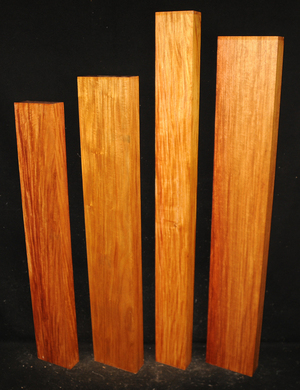
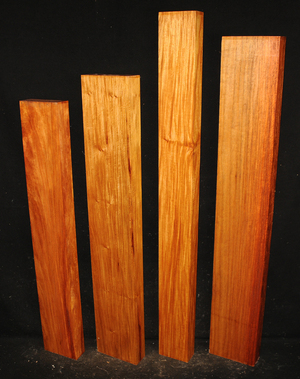
Figured Narra
Pterocarpus indicus
Also called New Guinea Rosewood. It is a beautiful, highly lustrous golden yellow color sometimes with reddish streaks. A nice turning wood it is also used in furniture, jewelry boxes, handles, etc. It is easy to work and glue and takes a nice polish.
Item Number: W44395
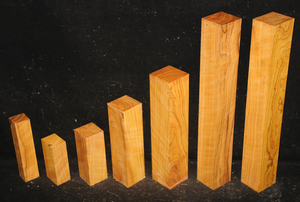
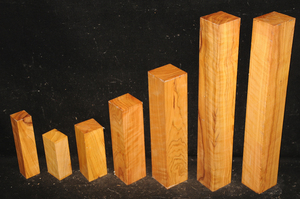
Wild Olivewood
Olea macrocarpa
A species of Olive from South Africa. Very rarely seen on the commercial timber market. It is similar in color to the European species but is denser and harder with more variegations of color and grain. Partially air-dried.
F has some small checks on the corner which will turn off.
Item Number: W44394
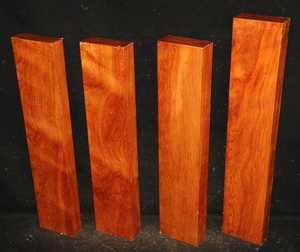
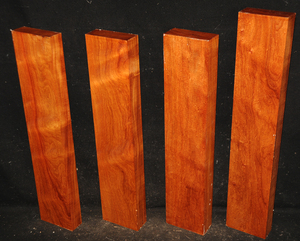
Narra
Pterocarpus indicus
Also called New Guinea Rosewood. It is a beautiful, highly lustrous golden yellow color sometimes with reddish streaks. A nice turning wood it is also used in furniture, jewelry boxes, handles, etc. It is easy to work and glue and takes a nice polish.
These have some figure on the edge.
Item Number: W44393
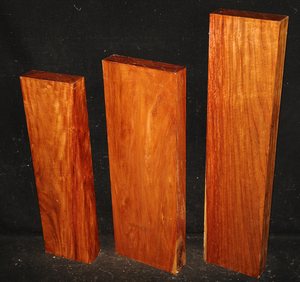
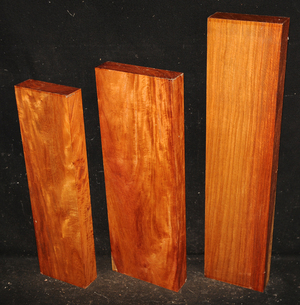
Figured Narra
Pterocarpus indicus
Also called New Guinea Rosewood. It is a beautiful, highly lustrous golden yellow color sometimes with reddish streaks. A nice turning wood it is also used in furniture, jewelry boxes, handles, etc. It is easy to work and glue and takes a nice polish.
Item Number: W44392
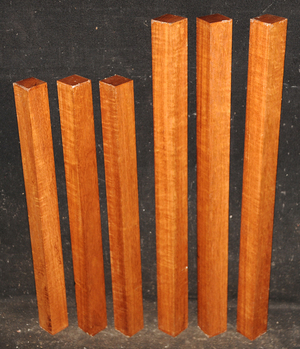
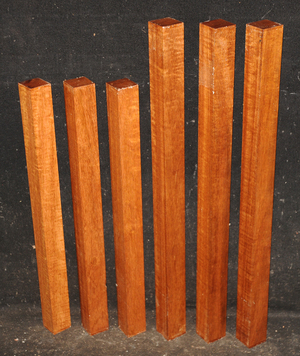
Figured Knobthorn Acacia Turning Squares
Acacia nigrescens
This South African tree is noted for its bark which has prominent knobby prickles. The heartwood is medium to dark brown and close grained. It is hard and heavy and takes a nice polish. Rare on the American market.
Item Number: W44390
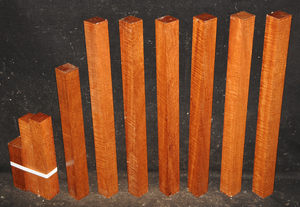
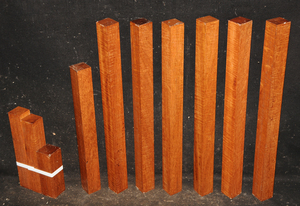
Figured Knobthorn Acacia Bundle & Turning Squares
Acacia nigrescens
This South African tree is noted for its bark which has prominent knobby prickles. The heartwood is medium to dark brown and close grained. It is hard and heavy and takes a nice polish. Rare on the American market.
A has 3 pieces.
Item Number: W44389
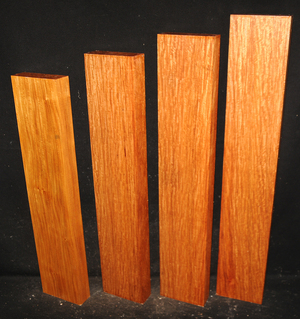
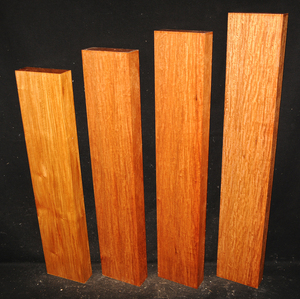
Figured Narra
Pterocarpus indicus
Also called New Guinea Rosewood. It is a beautiful, highly lustrous golden yellow color sometimes with reddish streaks. A nice turning wood it is also used in furniture, jewelry boxes, handles, etc. It is easy to work and glue and takes a nice polish.
A has a little less figure than the other 3 pieces, but is still quite nice.
Item Number: W44388